
Developing Opportunity Insights’ AI Strategy
Opportunity Insights (OI) is a non-partisan research and policy organization based at Harvard and directed by Professors Raj Chetty (Harvard), Nathan Hendren (MIT), and John Friedman (Brown). It uses large-scale data to study economic mobility and translate research into practice.
Opportunity Insights came to me looking for help deciding where to start with AI. That involved two linked forms of work: helping its researchers and staff build a shared foundation in agentic coding, and developing an organization-wide strategy for where AI could be useful and what OI should do first.
What makes developing OI's AI strategy difficult is that OI's "research production function" is much different from that of the average economist.
How OI's research production function differs from the typical economist, and why it matters
OI's work is distributed across a large team.
While typical applied economists work alone or on small teams, at OI, senior and junior researchers, pre-docs, Research Translation, operations staff, and external collaborators work together on complex years-long projects.
So, one of my core responsibilities was both helping OI upskill on AI and thinking carefully through project management with dozens of AI-accelerated researchers.
OI members have highly varied needs with AI.
Most economists are actively involved in all parts of research production: coding, thinking, making slides, and writing.
By contrast, each OI member is typically much more specialized. For example, PIs write papers themselves, but while they direct the creation of slides, pre-docs or research-translation staff are in charge of making edits to slides and tables/figures.
Similar divisions in responsibilities exist throughout OI's research production process. So, I had to think carefully about how to develop a training and strategy that took into account different stakeholders' varied needs.
Most of OI's research uses restricted data.
Most of OI's projects involve restricted data - often U.S. Census and tax microdata. These data can only be accessed at Census Research Data Centers, which are physical locations without Internet access - and so AI tools aren't permitted.
As a result, I had to help OI think through how and where to apply AI with this bottleneck, as well as evaluate potential workarounds (e.g. synthetic data and local LLMs).
Communicating research is a core component of OI's mandate.
For most economists, the research process ends at publication. For OI, that's just the beginning; OI treats public communication of its research findings as seriously as it does research production.
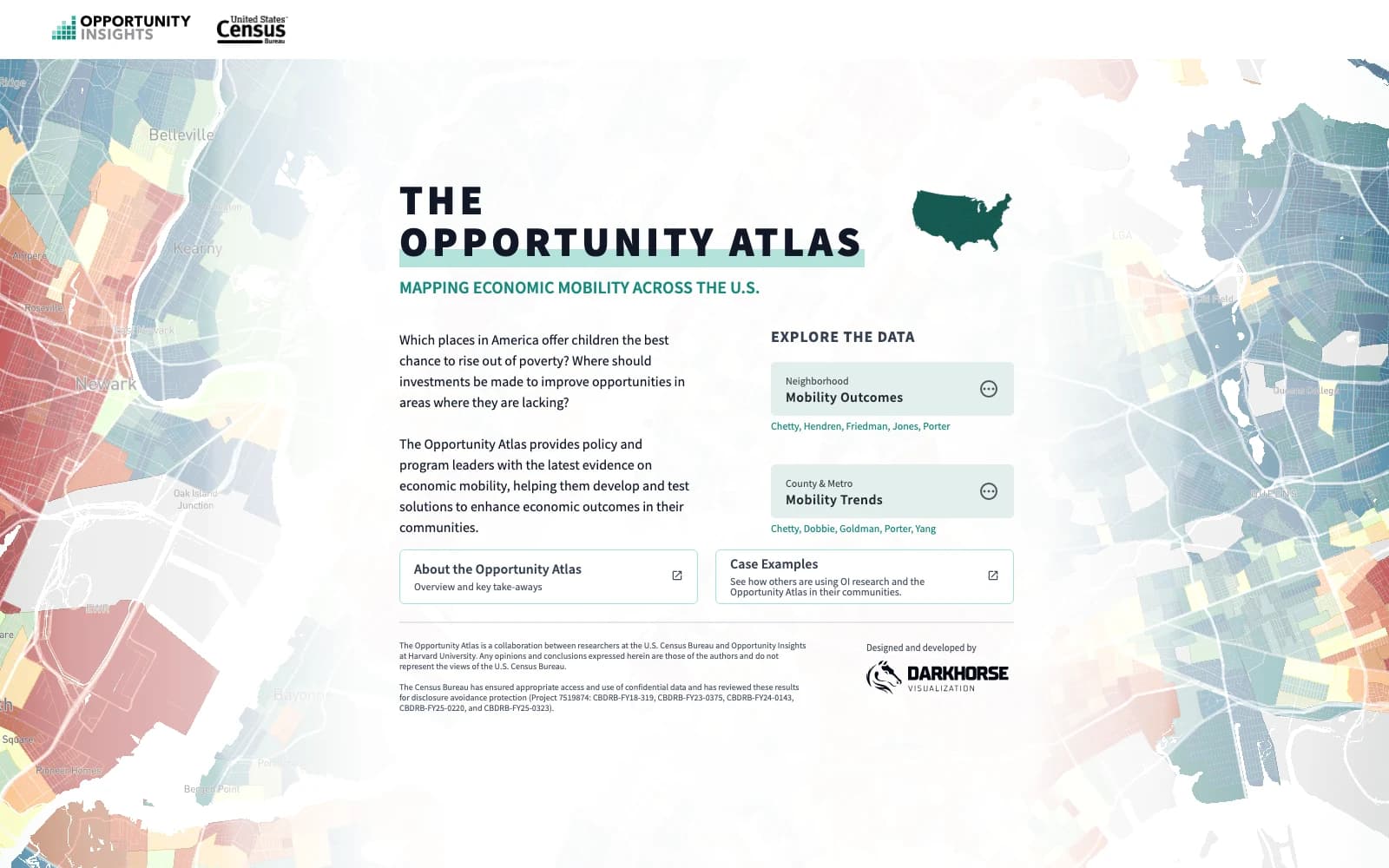
For example, OI maintains the popular Opportunity Atlas. Additionally, for each of their papers, OI publishes graphical non-technical summaries.
I helped OI think through how to accelerate with AI the production of these non-technical products, as well as develop better telemetry for how they're being used by the public.
Most of OI's work is organized through Slack.
While this seems like a small detail, giving AI the context it needs to be useful is extremely important for maximizing your use of AI.
So, a part of my engagement was helping OI make the case to Harvard - who blocks Slack connections to AI tools - to lift those restrictions.
From Individual AI Use to an Organization-Wide Strategy
While individual researchers at OI had begun using AI to augment their own productivity, OI had not yet systematically evaluated how AI should fit into the organization.
Through conversations with OI researchers and staff, we settled on an initial strategy:
- First, we would give people across OI a stronger baseline understanding of modern AI tools through a series of in-person agentic coding workshops over the course of a week.
- Second, during the week, I would have conversations with various staff and stakeholders at OI.
The aim of those conversations was to provide OI with a comprehensive roadmap for how best to integrate AI across its functions.
The engagement
Workshop-led AI strategy
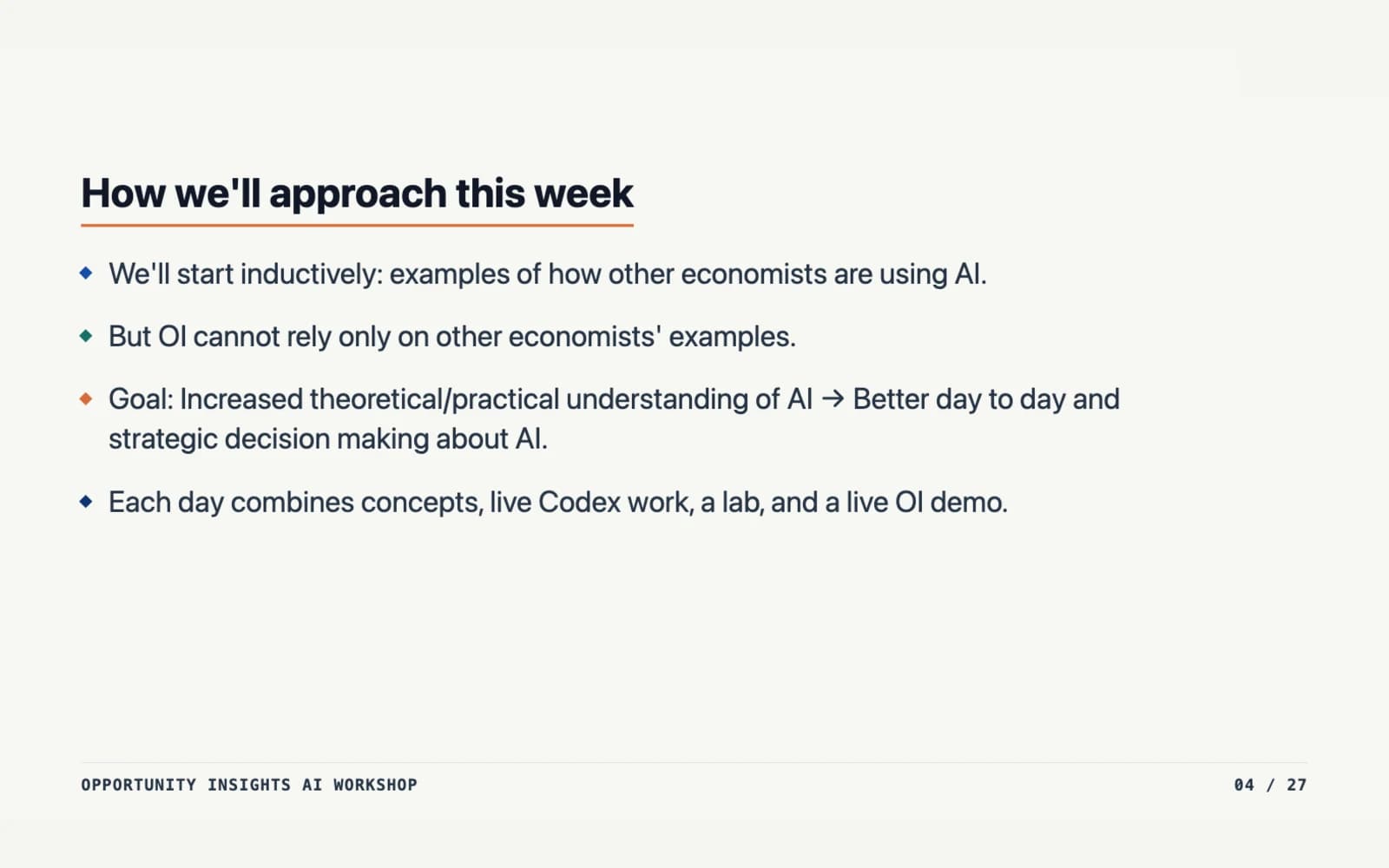
I prepared in coordination with OI three 90 minute workshops teaching the fundamentals of agentic coding. We focused on the Codex Desktop app, and designed the curriculum around OI's particular needs, including secure data environments, high-quality research artifacts, and integrating AI with Slack and email despite Harvard's restrictions.
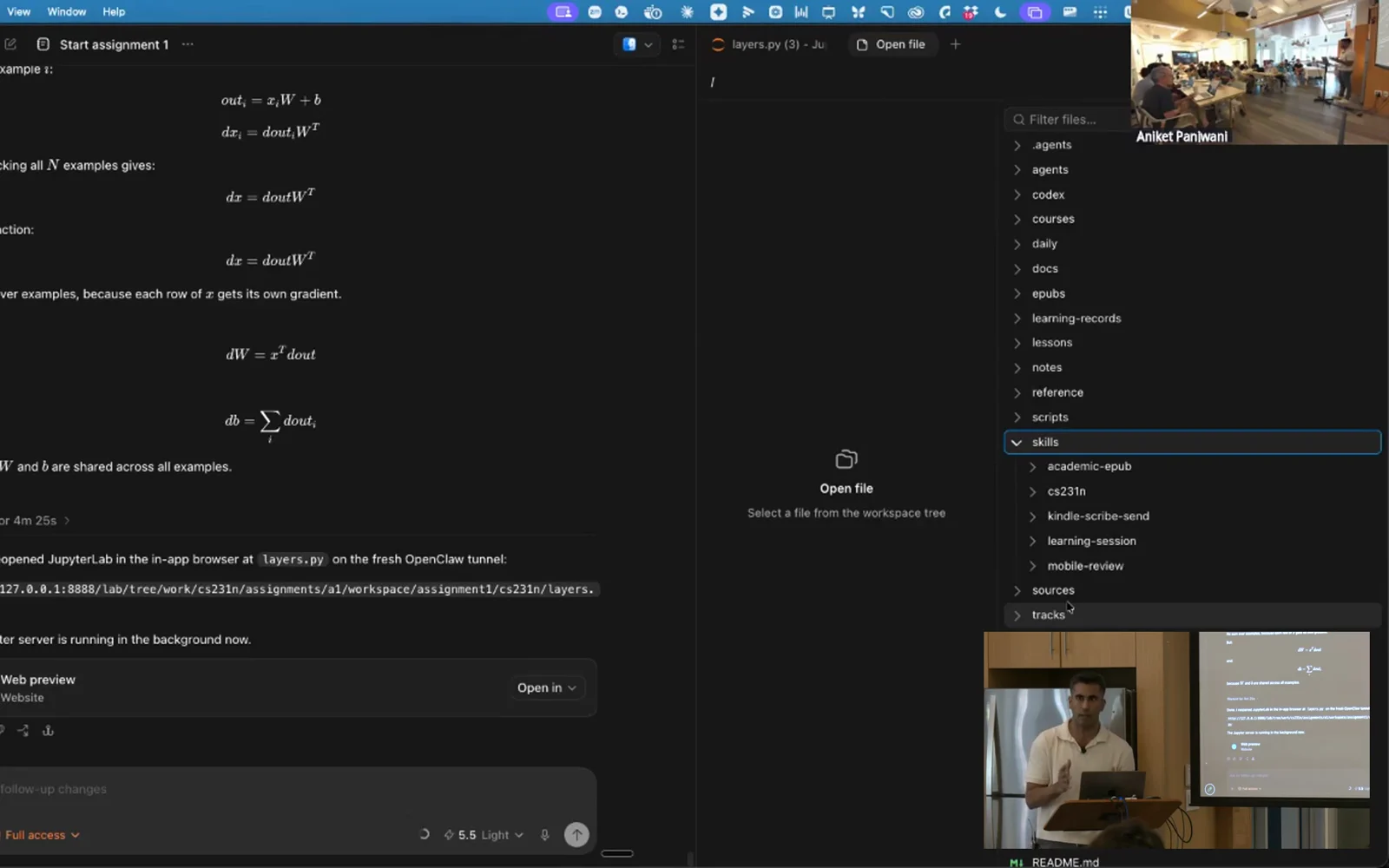
I also designed three 60 minute practical labs for participants, allowing them to put immediately into practice the material I presented. During the labs, I walked around the room to understand where participants were struggling and to give them a chance to ask me questions.
Before and during my week at OI, I spoke several times with every OI stakeholder—PIs, research staff, and pre-docs. I used this discovery process and the discussions generated through the workshops to deliver an AI Strategy and Implementation Roadmap to OI.
In the Roadmap, I outlined my evaluation of the greatest opportunities for OI to integrate AI, my suggestions on the exact order in which to implement them, and how OI could best adapt its AI strategy through experience.
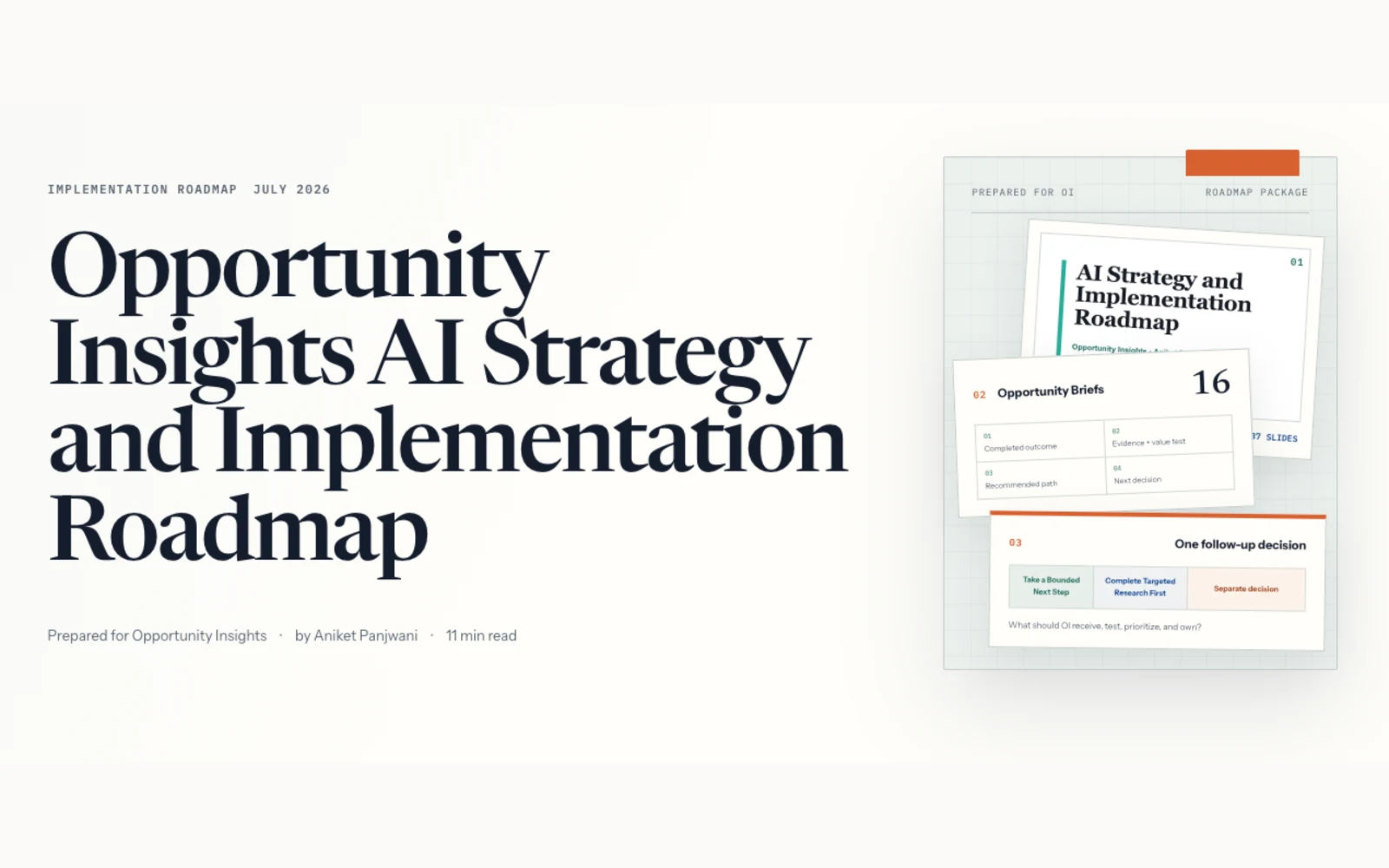
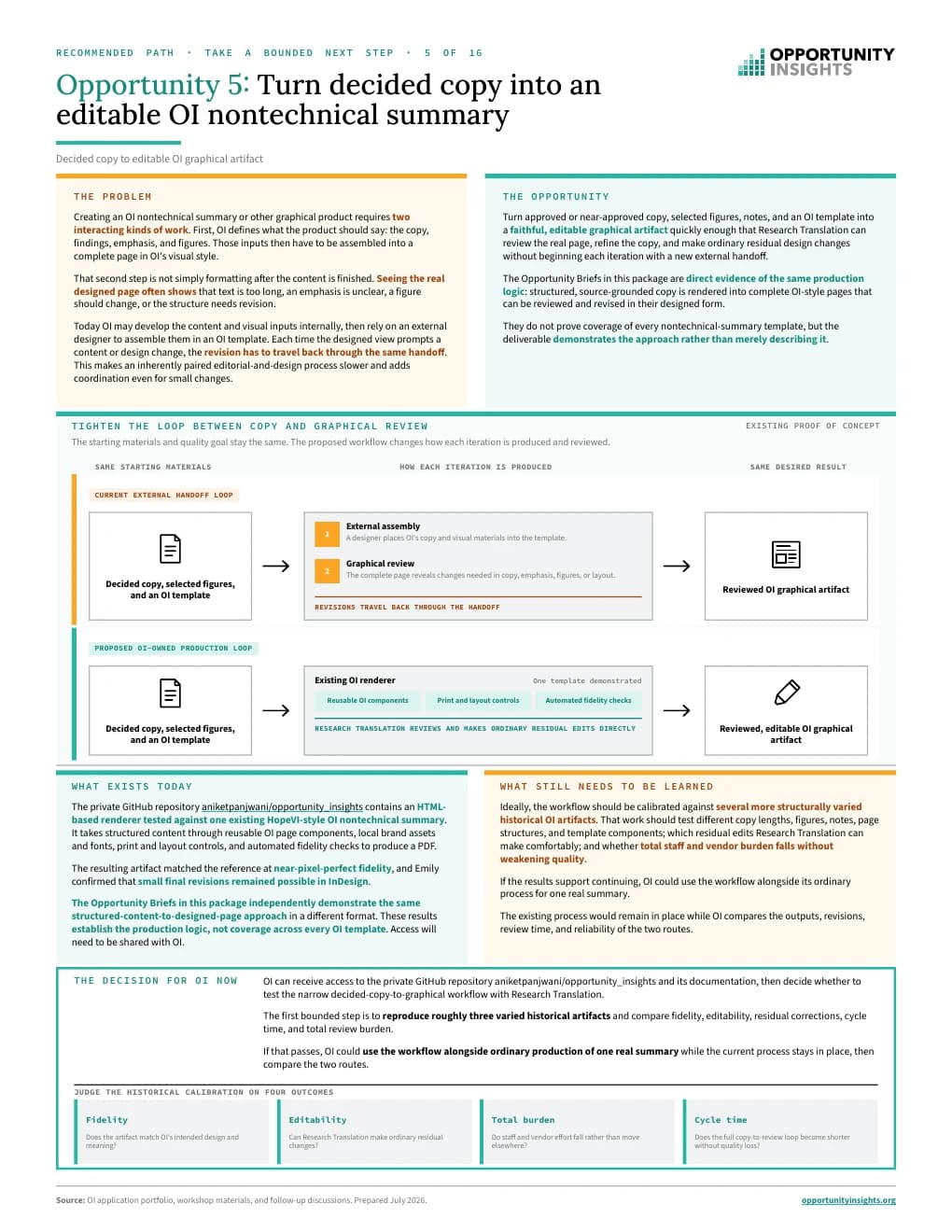
For each of 16 opportunities I identified, I produced a one-page Opportunity Brief. I created the briefs in OI's style as an implicit example of one of the opportunities: using AI to rapidly go from copy to a bespoke PDF without handoff to external design teams.
Interested in working with Aniket?
Book a call to discuss how Aniket can help your organization—whether through a one-off workshop, a series of trainings, or an extended engagement.
Book a consultation →